



HOPKINSVILLE, KY (CHRISTIAN COUNTY NOW) – City officials heard recommendations and data regarding a notable lack of new housing developments in Hopkinsville. Carter Hendricks, chairperson for the Housing Task Force, spoke to councilmembers during the Nov. 19 Hopkinsville Committee of the Whole meeting on this topic.
The task force was formed as a result of a housing study that was done from a third-party consultant around a year and a half ago. At the time, the consultant determined that Hopkinsville needed upwards of 3,000 more homes to keep up with growth, according to Hendricks.
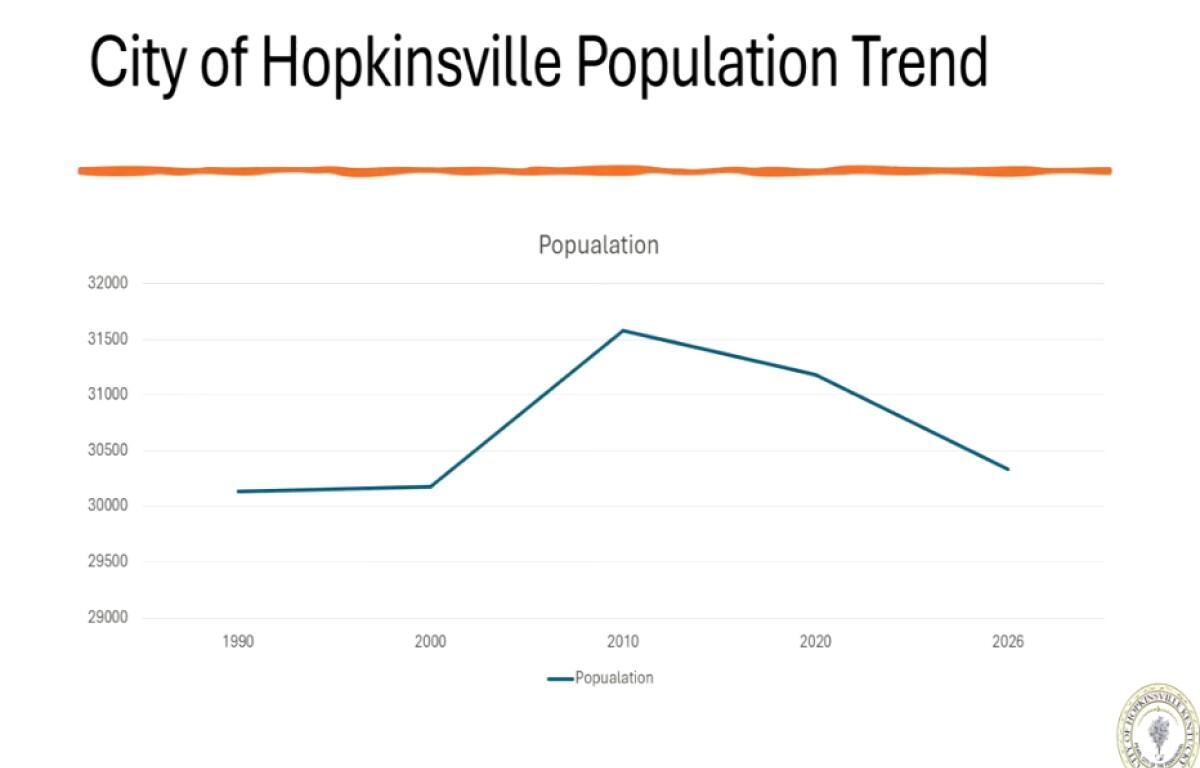
His presentation said, “Hopkinsville’s residential development, specifically single-family owner-occupied units, has not kept pace with residential losses and demand. Without sufficient residential development, Hopkinsville’s population has remained relatively stagnant since 1990.”
Data shows that the city’s population has stayed at or around 30,000 people for the past 35 years, with a noticeable steady decline after a spike in 2010 as shown in the graph below.
The presentation went on to say that although there have been substantial industrial developments in the city, 25% of large employee workers commute from Tennessee and do not live in Hopkinsville.
Plan to bring more housing
Hendricks shared that on average, around 40-50 single family housing permits are issued each year, which is nearly canceled out by homes that are demolished or uninhabitable. Duplex and multi-family units similarly have consistently low developments.
The task force is recommending that Hopkinsville has a target of developing 500 new single family residential units in the next four to five years at an average value of $250,000. This would be around twice the average that is currently being created. This could potentially bring around 4% growth to the area.
“We need to help developers mitigate some of the risk and cost associated with infrastructure development in particular,” said Hendricks about next steps. To promote this growth, the task force is recommending the city takes action in the following ways.
- Infrastructure Revolving Loan Fund
- Restructure Municipal Order 17-2017 (current incentive package)
- Local Residential Infrastructure Development District
- Require a Redevelopment Schedule
- Block-Scale Disposition of Land Bank Lots
- Full-Time Housing Attorney
It was additionally pointed out that more residential developments could also lead to more tax revenue, more small business and retail demand for existing businesses, more workforce talent, and more students in the school system.
No action items were presented to the council on this top during this meeting, but Hendricks suggested they add further discussion to a future business list.